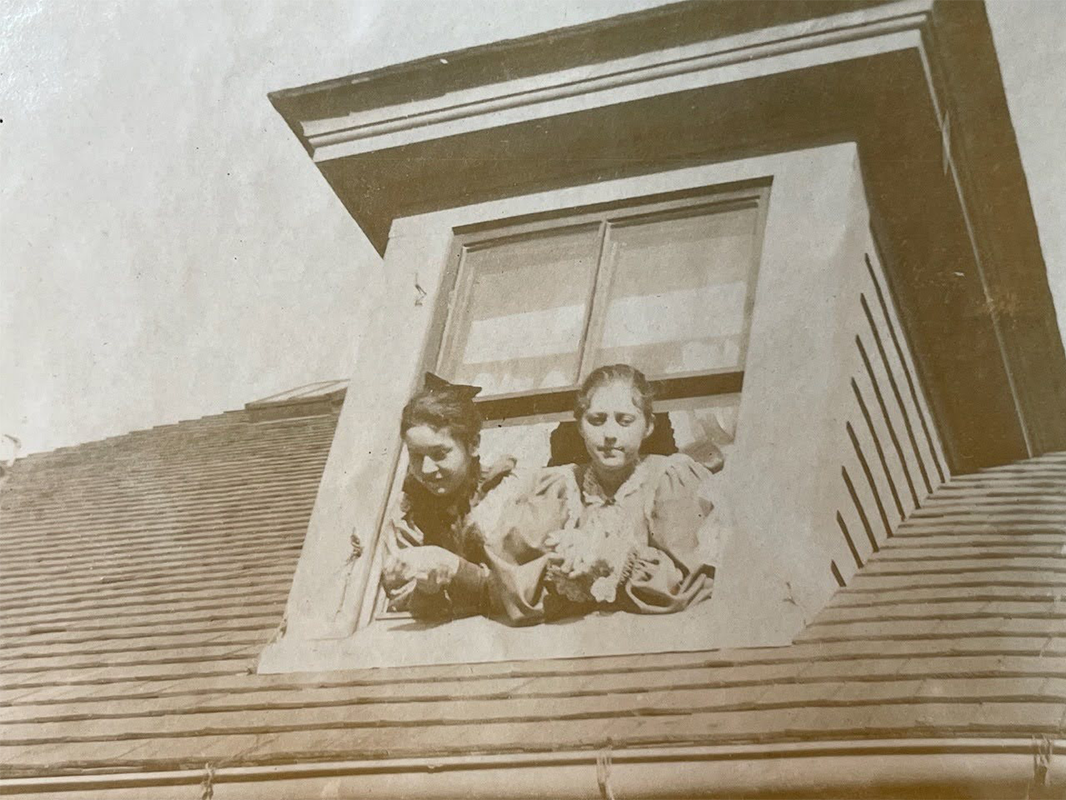
The Wing Sisters, Part III: The Wing Collection
Meredith Clowse ‘26 is an Art History Major and an Archives Concentrator at Smith. This research project is the culmination of her work as the Kennedy Fellow at SCMA the 2025-2026 academic year.
The Wing sisters began donating artwork to SCMA in 1951, when they were in their seventies, until they died in the late 1960s. These donations shed light on their personal taste in art and what they viewed as worthy of being given to the Museum. For more personal background on Caroline and Adeline Wing, refer back to Parts I & II of this series of blog posts.
Within the umbrella of the Wing sisters’ donations, I have chosen to focus on the oil paintings, which they gave in addition to many embroidered pieces, and a print series by Daumier. This is because at that time and now, paintings are higher valued (both monetarily and socially). The paintings they donated were often put on display right after, and shown off as proof of the museum’s resources and importance. Looking into the records now, the paintings leave a much stronger paper trail, and garnered much more reactions and comments from both the Wings and the Museum. So while I would like to have learned more about their other works, it made sense to focus on the paintings to understand their personal taste and impact on the museum.
These donations to Smith fall mostly into two categories: works they donated after having owned them for some years, and works they bought for Smith at the museum’s request and with museum staff’s guidance.
The Wing’s personal collection seems to have been composed mostly of landscape paintings by American and French artists. These are the only works that I have evidence of them hanging in their homes, and owning for years before bequesting them. Up until the early 1940s, the Wings had promised their personal art collection to Smith College. However, they ended up donating their works to Colby College Museum of Art in Maine instead (they also had a personal connection to this institution). This was because in the 1940s, according to SCMA director Robert Parks, the former museum director Jere Abbott “antagonized them in some way, and because of that they decided to leave their collection to Colby College instead of Smith.” (SCMA archives) This was confirmed in a letter from Adeline Wing in 1950, where she stated that the rift was because SCMA had “turned down some of our ‘art treasures’” (SCMA archives). In this letter, Adeline lists these works as being by “Childe Hassam, Winslow Homer, Dufy, Utrillo, Ogden Pleissner, etc.”(SCMA archives). I don’t believe that all of them ended up at Colby College, as in the 1950 letter Adeline wrote that they were given to “to other art galleries,” and didn’t specify Colby. However some of them went to Colby, as there was a major donation from the Wings to them around this time.
In the works they donated to Smith, there is evidence for two of them being in the Wings’ personal art collection before their donation. These are Afternoon In July by French artist Henri-Joseph Harpignies, and Mountain Brook, Adirondack by American artist Alexander Helwig Wyant.

Henri-Joseph Harpignies, Afternoon In July, July 1876, oil on canvas, 25 5/16 x 22 x 3 in., SC 1955.23 (left)
Alexander Helwig Wyant, Mountain Brook, Adirondack, n.d., oil on canvas, 48 1/2 x 36 3/8 in, SC. 1967.59. (right)
However, unlike these two works, the majority of what the Wings gifted to Smith were paintings they bought for the museum, or were donations arranged by the museum and financed by the sisters. The difference in subject matter could be partially due to this different process than acquiring art for themselves, but also could be about the different goals of the museum. What is certain is that the Wing sisters’ donations were affected by their personal taste in art. This is most clearly shown by looking at the arc of their donations to Smith.

Two of their early donations to SCMA (in 1951 and 1956) were of American paintings at the behest of the museum, however it seems the sisters were displeased by these choices. The Wings donated the painting The Conversion of Saint Paul by Benjamin West in 1951. This painting was one the museum proposed the Wings buy for them, and they agreed. Apparently sometime in the buying process, the Wings decided they did not like the painting by West. This didn’t prevent the acquisition, however it changed what they donated to Smith in future. According to Robert Parks, a director of the museum who knew the Wings, he thought their issue was connected to their faith. He wrote that “It was not Unitarian enough for these Uniterians!” which looking at this work makes sense (SCMA archives). This piece was created for an Anglican church in England, and in a dramatic style consistent with lavish emotionally-driven religious art. This is a very different ethos around religious art compared to American Protestant traditions, especially those stemming from the Puritan tradition. It makes sense that the sisters’ artistic sensibilities around religious subjects would be drawn from the denomination they grew up and remained in. So regardless of how they viewed the work’s academic and teaching value, the work was not something they valued for its own aesthetics.

Benjamin West, The Conversion of Saint Paul (center); Saint Paul Persecuting the Christians (left); and Ananias Restoring Saint Paul's Sight (right), 1786, oil on canvas, 56 x 54 in, SC 1951.169.
In 1956, their donation of Reading the Legend by Lilly Martin Spencer went in a similar manner. The museum wrote to them asking if they would be generous enough to acquire this painting on behalf of the museum. It is by an American woman artist and “admired as an example of Victorian sentimental and romantic genre” (SCMA archives). However, again after the purchase the Wings went to Director Robert Parks to say that they “think it is a silly picture” and told him “don’t ever ask us to buy anything more like that” (SCMA archives). At this point, in 1955, is when Parks recounted these mishaps, and looking at their future donations, it’s clear he learned from these mistakes. From here on, all of the paintings the museum suggested they donate were European in origin and more care was taken to cater to their tastes. Their relationship with the museum staff also appeared to get more friendly, especially with Parks.

Lilly Martin Spencer, Reading the Legend, 1852, oil on canvas, 57 1/4 x 43 3/8 x 4 in, SC 1954.69.
One element that unites these later donations is a sense of seriousness. One of the few references to taste in the correspondence about these later-donated works alludes to this. This reference comes during their donation of the piece Still Life with Siegburger Jug by Bosschaert. In an unsigned letter someone from the museum assures the Wings that they will like this painting because “The austere, straight-foward yet elegant design of the Still Life is definitely related to the Spanish still-life painting of this time” which is a genre they enjoyed (SCMA archives). This description is the opposite of their objections to the works by West and Spencer; it is neither extravagant nor frivolous.

Ambrosius Bosschaert the elder, Fruit Dish with Siegburger Jug, c. 1590-1615, oil on panel, 17 1/4 x 24 1/4 in, SC 1963.62.
The formal qualities of the paintings donated by the Wings around this time match this description. The colors of these images appear darker than the landscapes they bought for their home. The techniques (excepting Monet’s impressionism) are more realistic, and in line with the traditional hierarchies of visual arts. The time periods and artists they donated were earlier and ‘historic’ at the time. The works they deemed fit to be bought for Smith students were works considered historically valuable enough for serious academic study. For the Wings, this idea of value would have been developed during their Smith education. While their correspondence shows that they did like these works, their preference for more picturesque landscapes in their home means that this was not the only artwork they liked. Rather, it seems that their choices in donations were geared towards the education of students, and less so in their aesthetic enjoyment of art alone.

Jan Steen, The Drinker, c. 1660-1665, oil on panel, 14 3/4 x 11 3/4 in, SC 1957.36. (left)
Elizabeth Emma Soyer, The Thompson Brothers Fishing, c.1818-1820, oil on canvas, 54 x 60 in, SC 1960.40 (right)
The Wing sister’s legacy at SCMA is still felt today. As early, very significant donors, they helped shape SCMA into the institution and collection it is. Many of the works they donated kicked off areas of strength in the museum’s collection, which have been built upon over time. One example is landscapes. The Harpignes they donated was the first of the Barbizon school of French landscape artists donated to Smith, which has grown into a strong collection since. The Dutch art they donated has been similarly compounded over time. On the business side, their works still comprise many of the major assets of the Museum, both in terms of finances and works that people come to see. This is exemplified by the number of works they donated that remain on display. Out of the sixteen paintings they donated, four are currently on view: The Cathedral at Rouen (La Cour d’Albane) by Claude Monet, Old Man Writing by Candlelight by Hendrick Terbrugghen, The Drinker by Jan Steen, and Fruit Dish with Siegburger Jug by Ambrosious Bosschaert the elder. According to the collections catalog online, only about 1.5 % of SCMA’s collection is on view right now (412 out of 26452 total works), and about 9% of the total oil paintings are on view. So the fact that that includes four out of the sixteen oil paintings they gave is an impressive proportion.
In addition to this importance, their unique lives reveal how they took advantage of the freedom which their money, education, race and class allowed. Their Smith education and upbringing led them into academic and artistic pursuits, which through their personal values and access to wealth they decided to later return to Smith through their art donations. Robert Parks remarked to the Wings, in a letter from July 30, 1957 after their donation of The Drinker by Jan Steen, that “You are certainly creating a transformation in the Smith College Museum with your wonderful gifts and, or course, what you are giving to Smith is not only for the College, but for the nation.” When I first came across this I dismissed it as blatant flattery on the part of Parks, but after some time his words ring true. The Wing sisters did transform the development of the art museum, but more than that, their legacy also represents their wishes for the future. Through the circumstances of their family, they were able to pursue education for themselves through schooling, travel, and the money to purchase important works of art. This gift is something they chose to give back to Smith students, and because of it, Smithies like myself have access to a high-quality art history education, and the resources to pursue our academic interests. A precious gift indeed!

Photos from Adeline Wing. Photo Albums. n.d. Box 1567. Classes of 1891-1900 records, Smith College Archives, CA-MS-01022, Smith College Special Collections, Northampton, Massachusetts.

Adeline Wing. Photo Albums. n.d. Box 1567. Classes of 1891-1900 records, Smith College Archives, CA-MS-01022, Smith College Special Collections, Northampton, Massachusetts.
Check out Part II to go learn more about the Wing sisters' adult lives!
Or
If you haven’t read about their early lives, go back to Part I!
To find out more about the Wing Sisters, please find a bibliography and additional resources linked here.