connecting people to art
Curatorial and Collection Development
Smith College Museum of Art is widely acknowledged among the country’s leading teaching museums, with one of the strongest collections of any undergraduate liberal arts college in the nation.
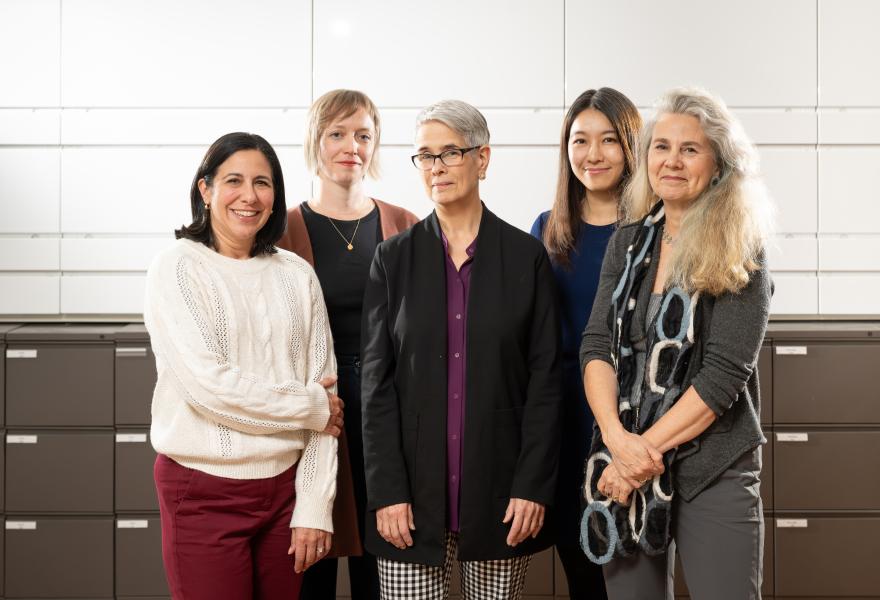
Over the last decade, SCMA has been thoughtfully expanding our curatorial department and working collaboratively to develop the collection in ways that reflect the full spectrum of creative voices across history. Today, we have an integrated team with overlapping specialties in different cultures, time periods and media: Jessica Nicoll, Director and Louise Ines Doyle ’34 Chief Curator; Aprile Gallant, Mary Walcott Keyes 1931 Curator of Prints, Drawings and Photographs and Associate Director of Curatorial Affairs; Danielle Carrabino, Curator of Painting and Sculpture; Emma Chubb, Charlotte Feng Ford ’83 Curator of Contemporary Art; Henriette Kets de Vries, Cunningham Center Manager and Associate Curator of Prints, Drawings and Photographs; and Clara Cho Wun Ma, Jane Chace Carroll Associate Curator of Asian Art.
It is of utmost importance to us that all people see themselves represented here; that weare telling not just one story, but many. This is reflected in a number of exciting recent acquisitions, from targeted individual purchases to donations from collectors. Their generosity and partnership has helped us make great progress in developing new areas of the collection while also allowing us to build depth and breadth in areas of historical strength.
VOICES
SAMUEL C. MORSE
Professor of the History of Art and Asian Languages and Civilizations, Amherst College
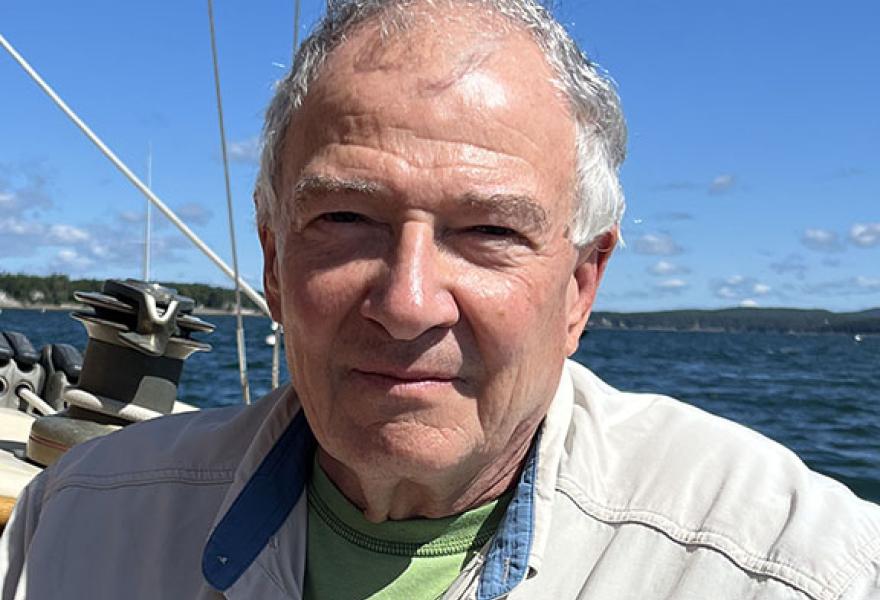
Sharing a bowl of matcha surrounded by carefully selected objects has an important place in Japanese culture. The practice of chanoyu (“hot water for tea” in Japan and often somewhat mistakenly called “the tea ceremony” in the West) began in the 15th century, was refined in the 16th century by Sen no Rikyū (1522–1591) and maintains its popularity to the present day. Among those who prepared matcha in the past and continue to do so today, only a few are known as a Chajin—a person known for deep insights into the objects and practices of chanoyu. Richard Danziger, who passed away on November 9, 2024, was one such person, as is his wife Peggy Block Danziger ’62.
The Danzigers’ encounter with chanoyu began in the 1970s. Over the following 50 years they assembled a superb collection of the various objects essential to chanoyu, from tea bowls and hanging scrolls to incense containers and the feathers used to sweep the hearth.
In 2007, objects from the Danzigers’ collection formed the core of SCMA’s exhibition Fashioning Tradition—Japanese Tea Wares from the 16th and 17th Centuries. Many were subsequently given to the museum. Last year the Danzigers added seven hanging scrolls to the collection—one ink landscape, two ink figure paintings and four calligraphies. A hanging scroll generally sets the tone for chanoyu. The poem by Tonna Hōshi (1289–1372), which makes reference to kerria flowers and the passing of seasons, would be appropriate for spring. The hand-drawn circle (ensō) by Sōgan Soi (1588–1661), draws on powerful Buddhist themes of enlightenment and emptiness and might establish a mood of self-reflection.
True Chajin are also known for their aesthetic discernment and ability to make unexpected arrangements of objects. Dick Danziger would have been equally delighted to place a lithograph from Hiroshi Sugimoto (born 1948) and his late 20th-century series Time Exposed with a 17th-century Oribe ware tea bowl. These new gifts thus not only expand the museum’s collection of Japanese and contemporary art but also offer insight into the sensibilities of two collectors whose tastes have been refined by the practice of chanoyu.

SYLVIA SMITH LEWIS ’74
“We [Sylvia Smith Lewis ’74 and Byron E. Lewis Sr.] chose to donate our art to Smith because the campus museum has done tremendous reparative work, as have other major museums, to include African American, Caribbean, and African art, which is our primary collection. When all is said and done about African Americans and our complicated history, it will be our art that will bring about understanding and positive change.”
In June 2024 we acquired Portrait of a Lady with a Chiqueador by an unknown Peruvian artist from the late 17th century, the first Spanish colonial painting in SCMA’s collection. It shows an elegantly dressed criolla woman (born to Spanish parents in Peru), perhaps to commemorate her wedding. While some characteristics are consistent with European portraiture, Indigenous traditions are prominent as well, from the woman’s braided hair to her jewelry of pearl and onyx, a material that was typically mined in colonial South America by enslaved laborers. Our research into the artist and sitter is ongoing, but bringing this work into our collection provides an opportunity to present a more comprehensive history of objects of global exchange.

This broad commitment to celebrating the richness of human creativity has also been supported in other significant ways. From February to September 2024, SCMA presented A Beacon to the World: Art from the Sylvia Smith Lewis ’74 and Byron E. Lewis Sr. Collection, an exhibition showcasing artists of the African diaspora, including Richmond Barthe (1901–1989), Romare Bearden (1911–1988), Betty Blayton-Taylor (1937–2016), Fred Brown (1945–2012), and Richard J. Watson (born 1946). The Lewises’ generous gift of more than 35 works of art not only expands SCMA’s representation of work by Black artists but also tells the story of visionary and activist collectors.


Another recent and greatly appreciated gift comes from art historian and Smith alumna Andrea Henderson Fahnestock ’80, whose area of professional expertise and personal interest is primarily 19th-century art. We are grateful to Fahnestock for her donation of important works by American artists including Sanford Robinson Gifford (1823–1880), William Stanley Haseltine (1835–1900), Josephine Miles Lewis (1865–1959), and Jane Peterson (1876–1965), enriching the experiences of future generations of Smith students, faculty, and visitors. Transformative gifts continue to play an ever-increasing role in the museum’s ability to expand and shape the collection, accounting for more than 70 percent of new acquisitions.
SCMA’s permanent collection is used in myriad ways on a daily basis. Teaching often begins, but does not end, with the artworks displayed in the main galleries. Informal displays in the Winslow Teaching Gallery and visits to the Cunningham Center for the Study of Prints, Drawings and Photographs are additional and valuable ways in which students, faculty, and visitors enjoy direct and rich encounters with art.


In March 2023, we held our first college class in the newly reopened Cunningham Center, following a multiyear renovation to ensure that the entire collection of more than 24,000 works on paper can remain on site and readily accessible to our community. Additional upgrades have made the space increasingly friendly and functional, with easily configurable tables and seating, along with state-of-the-art technology.
It did not take long for the Cunningham Center to be fully operational once again. We welcomed an influx of K–12 classes, as it has become an excellent place for younger students to focus on art without the distractions sometimes present in larger museum galleries. We also saw a marked increase in faculty use as well as singular student appointments from students across the Five Colleges, for individual study, or just because.
In perhaps one of the more original new uses of the space, we hosted six pop-up exhibitions from fall 2024 through spring 2025, bringing hundreds of visitors—and many first-timers—to the museum. These events included a People’s Pop-up, with selections determined by popular vote through social media; pop-ups in partnership with campus groups such as the Imaging Center and the Faculty and Staff Trans, Nonbinary, and Questioning Affinity group; and student-curated pop-ups.
Innovation is alive and well at SCMA on a larger scale, too. Younes Rahmoun: Here, Now—featuring works by contemporary Moroccan artist Younes Rahmoun (born 1975)—was a multi-disciplinary, sensory experience with one installation at the Botanic Garden and two outdoor installations on campus in addition to art displayed inside the museum’s galleries and windows. The exhibition, which ran from August 2024 to July 2025, included 15 works created by Rahmoun over the last 25 years inspired by materials and meaning from his daily life. Younes Rahmoun: Here, Now was curated by Emma Chubb, who met Rahmoun in 2007 in Morocco’s Rif Mountains. Their exchanges and collaborations in the years since led to this first-ever North American exhibition of his work.


Younes Rahmoun: Here, Now was made possible in part by generous support from Charlotte Feng Ford ’83. Building on her transformative gift that established and endowed the museum’s curatorship of contemporary art, Ford marked her 40th Smith reunion by offering a generous $500,000 challenge grant to establish a $1 million Fund for Contemporary Art. Thanks to her leadership, and the enthusiastic response by SCMA’s donors, we were able to meet the challenge for this fund, which will directly support activities including artist residencies, educational programs, acquisitions, research, exhibitions, publications, art conservation, and curatorial travel.
At SCMA we recognize that our collection as a whole is the beating heart of what we do in support of teaching and learning at Smith. To do it well requires us to understand and embrace the interconnectedness of our efforts and the opportunities that arise as a result.
VOICES

NIKOLAS ASIKIS
Chief Preparator
From bringing the large brass sculpture Markaba out to the lawn for outdoor photography to coordinating the installation of art at five sites on the Smith campus, the exhibition Younes Rahmoun: Here, Now had the preparation team moving full speed ahead for over a year. Our work began a few months before Younes’s March 2023 visit to discuss his installation and ended just hours before the opening on August 30, 2024.
We drilled a combined estimate of 1,000 pinholes into the walls to install four different artworks in three different galleries. Additionally, we used 500 pounds of concrete to fabricate Younes’s Nakhla-Saghira sculptures. Four art handlers, our exhibition manager, two registrars, and at least nine subcontractors were all working behind the scenes to bring this exhibition to fruition.
Younes was a pleasure to work with, and it was such a memorable experience to bring his vision to life. We thought about how the visitor would interact with every piece and installed the artworks in a way that would best connect them to Younes’s ideas of what the work was about. We considered details such as the amount of space and height of each work, the paths a visitor might take through the exhibition, and how they would approach works that faced Qibla—the direction of Mecca. Everything was carefully laid out, moving things vertically and horizontally down to the inch, down to the last minute—and we made it work.
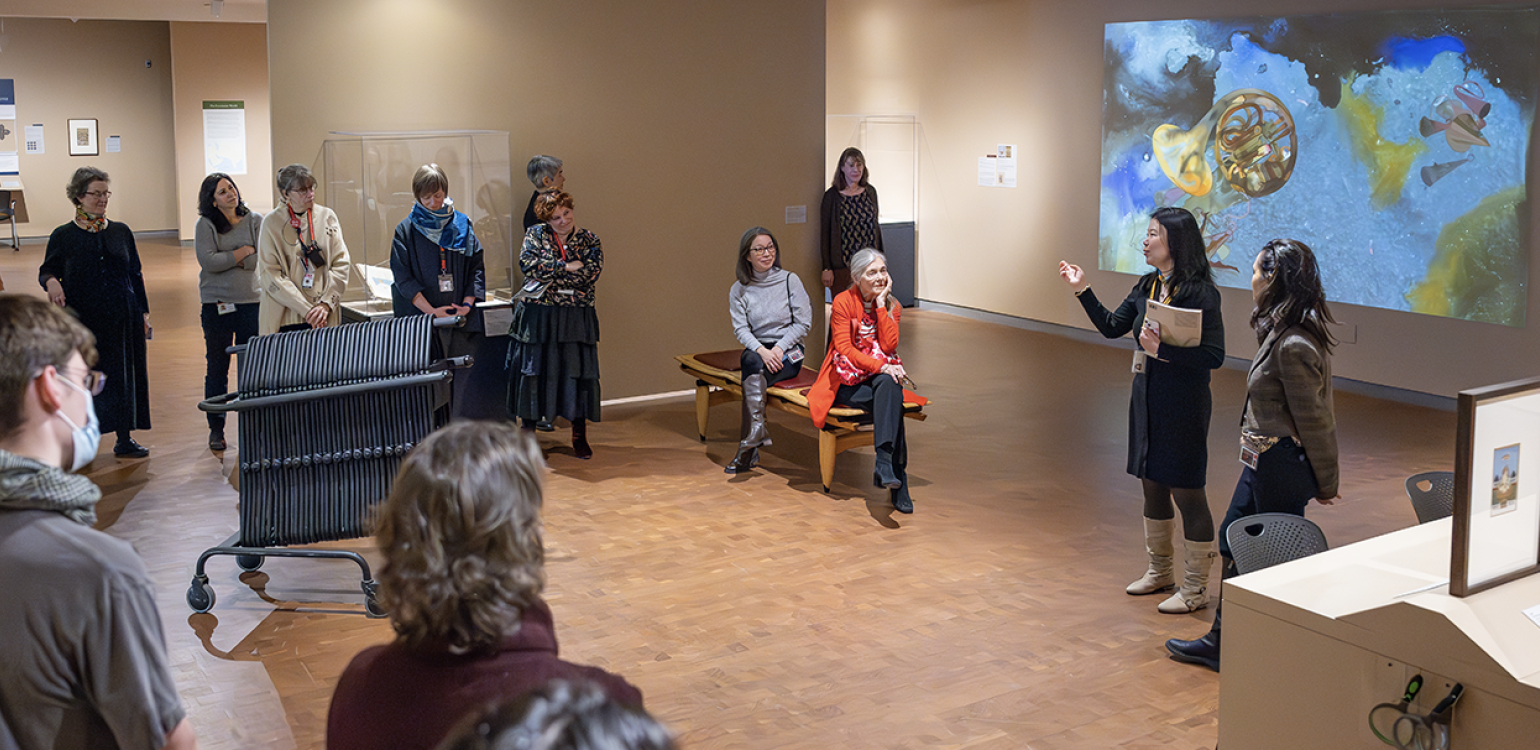
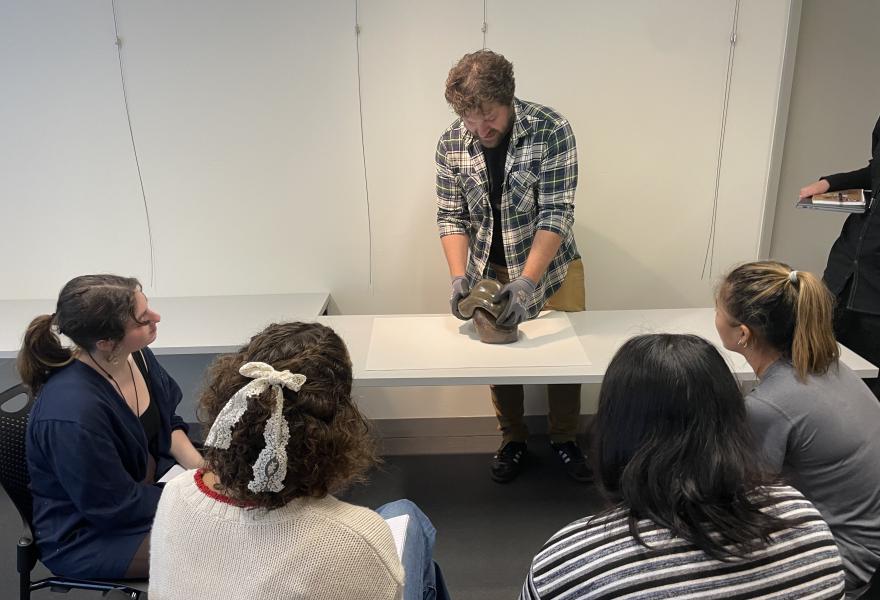
top to bottom, left to right: Artist Shahzia Sikander and Yao Wu, SCMA’s former Jane Chace Carroll Curator of Asian Art, give a gallery talk in Painting the Persianate World: Portable Images on Paper, Cloth and Clay, following the February 2024 Miller Lecture by Sikander. Photo by Derek Fowles Photography; Curators (left to right) Danielle Carrabino, Emma Chubb, Aprile Gallant, Clara Cho Wun Ma, and Henriette Kets de Vries. Photo by Derek Fowles Photography; In the Mellon Classroom, SCMA Preparator Matthew Cummings shows a Saloua Raouda Choucair fiberglass sculpture to students in CHM 100 Chemistry of Art Objects, taught by Professor Elizabeth Jamieson. Photo by Charlene Shang Miller; Photo courtesy of Samuel C. Morse; Sylvia Smith Lewis ‘74 (right) with Museum Visiting Committee Member Beverly Morgan-Welch ‘74 (left). Photo detail by Derek Fowles Photography; Unknown. Peruvian; Cuzco School. Portrait of a Lady with a Chiqueador, ca. 1690–1710. Oil on canvas. Purchased with the Beatrice Oenslager Chace, class of 1928, Fund. Photo by Stephen Petegorsky/Jim Gipe; Jane Peterson. American, 1876–1965. Venice Scene, ca. 1922. Oil on board. Gift of Andrea Henderson Fahnestock ‘80, in memory of my husband, George Andrew Hambrecht (Yale ‘67) who was my partner in putting together our collection of paintings of Italy, and elsewhere, by American artists. Photo by Stephen Petegorsky/Jim Gipe; Two visitors study art in the Cunningham Center during a Reunion I/Commencement pop-up exhibition. Photo by Derek Fowles Photography; Visitors at the August 2024 People’s Pop-up, the museum’s first exhibition curated by and for our audiences, created by Post-Baccalaureate Marketing Fellow Julia Giguere. Photo by Martha Ebner; In September 2024, artist Younes Rahmoun (left) and SCMA curator Emma Chubb (right) led a student walk at the Smith College MacLeish Field Station to experience the outdoor installation Ghorfa #13. This event was hosted by the Smith College Center for the Environment, Ecological Design and Sustainability (CEEDS). Artwork: Younes Rahmoun. Moroccan, born 1975. Ghorfa #13 (Al-Ana/Huna), (Room #13 [Here/Now]), 2024. Douglas fir, pine, steel, glass, and acrylic. Courtesy of the artist and Galerie Imane Farès, Paris. Photos 10–15 by Samm Smith; Artist Younes Rahmoun prepares his artwork Markaba (Vessel), 2016/2024, for photography prior to installation in the museum’s lower level gallery. Photo by Jess Scranton; Chief Preparator Nikolas Asikis (right) and Registration and Preparation Assistant Leah Hughes (left) unpack one of Younes Rahmoun’s artwork to ensure it arrived safely. Photo by Kelly Holbert